
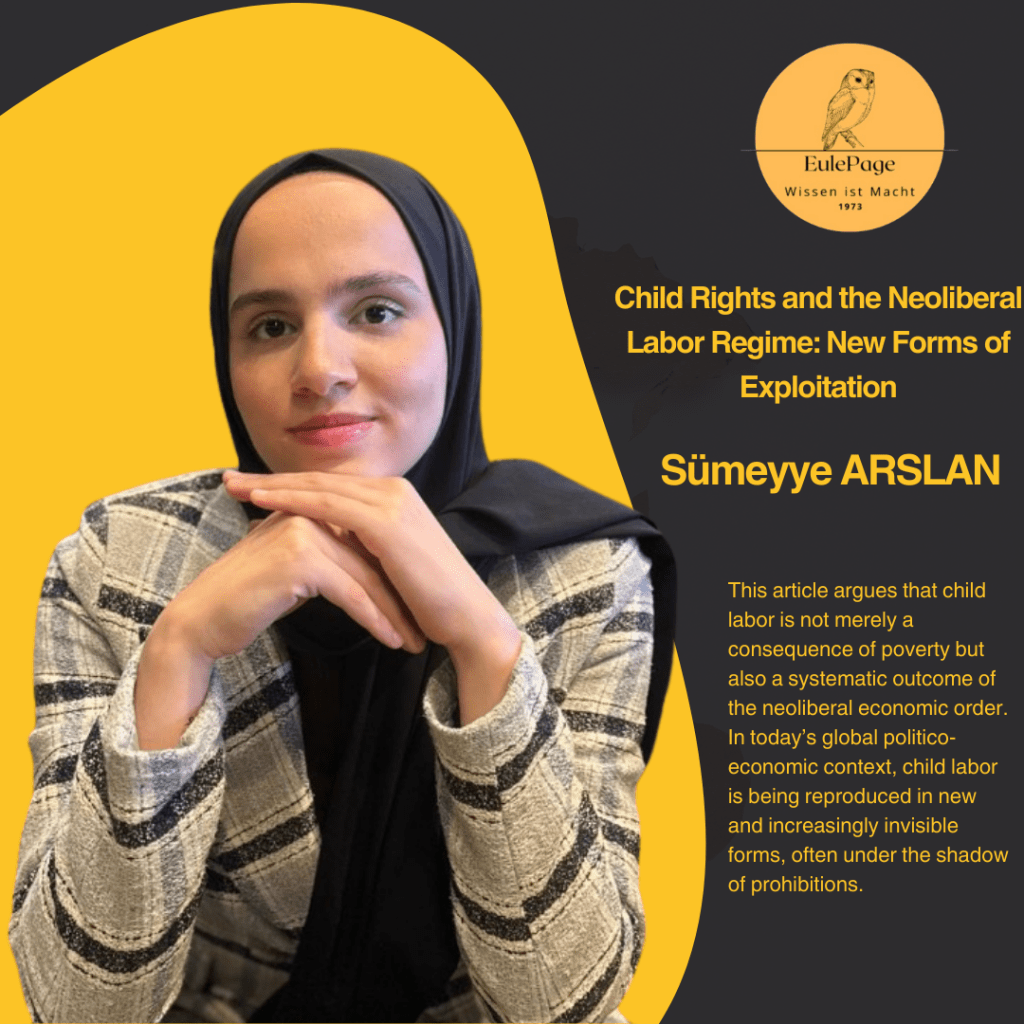
Child Rights and the Neoliberal Labor Regime: New Forms of Exploitation
Abstract
This article argues that child labor is not merely a consequence of poverty but also a systematic outcome of the neoliberal economic order. In today’s global politico-economic context, child labor is being reproduced in new and increasingly invisible forms, often under the shadow of prohibitions. This study examines violations of children’s rights in connection with the neoliberal labor regime, while also pointing to spaces of resistance.
Introduction
Child labor is a phenomenon that has existed throughout various periods in history. However, since the late 20th century, changing forms of production and employment have rendered this phenomenon more complex and less visible. The neoliberal labor regime has transformed not only the living conditions of the working class but also those of children.
According to UNICEF’s 2023 data, there are more than 160 million child laborers worldwide. One-third of this number falls under the category of “hazardous work.” Despite legal prohibitions and international conventions, child labor continues to exist in various forms. It is clear that behind this transformation lies the invisible yet powerful influence of the neoliberal system.
Neoliberalism and the Transformation of Labor Forms
Neoliberalism can be defined as an ideology that essentially reduces the role of the state in the social sphere and absolutizes free market relations. In line with this ideology, public domains such as education, health, and child welfare have been commercialized, and children have been integrated into the labor force, either directly or indirectly.
“Neoliberalism is not just about the economy; it is also a system of values. It forces people to think in market terms.”
— David Harvey, A Brief History of Neoliberalism (2005)
In this context, children have become the invisible link in the production chain; they continue to be employed in low-paid, insecure, and unregulated conditions at home, on the streets, in agriculture, or in the informal service sectors.
New Forms of Exploitation: The Visible Crisis of Invisible Labor
Today, child labor manifests in forms that are vastly different from the traditional image of children working in heavy industry:
- Domestic care labor: Especially among girls, caregiving responsibilities within the household often lead to exclusion from education.
- Digital labor: Children producing content on social media represent a new form of exploitation that blurs the boundaries between play, work, and performance.
- Seasonal agricultural labor: In rural areas, children are forced to contribute to family income at the cost of their right to access education.
“Poverty itself is not the cause of child labor; it is the product of systemic inequalities.”
— Jean Ziegler, The Right to Food (2001)
The Economic Grip on Child Rights
The United Nations Convention on the Rights of the Child (1989) explicitly states that children should be protected from involvement in labor. However, there are structural problems in the implementation of this convention. In countries dominated by neoliberal policies, children’s rights are often disregarded in favor of profit maximization, and child labor is structurally encouraged.
Policies that tie education to market demands, condition social assistance programs, and aim to reduce labor costs severely undermine children’s rights in a systematic and ongoing manner.
Conclusion and Evaluation
Under the neoliberal labor regime, child labor has become not merely a violation but a systemic necessity. Therefore, combating child labor requires more than just legal measures; it demands a redefinition of economic justice, social equality, and public responsibility.
Children are not part of the labor force—they are the shared conscience and the future of society. A system that exploits children ultimately consumes not only childhood but humanity itself.
“We will change the world not with a child’s labor, but with their dreams.”
— Sümeyye ARSLAN
Sümeyye ARSLAN
 EulePage
Yorum yazabilmek için oturum açmalısınız.