
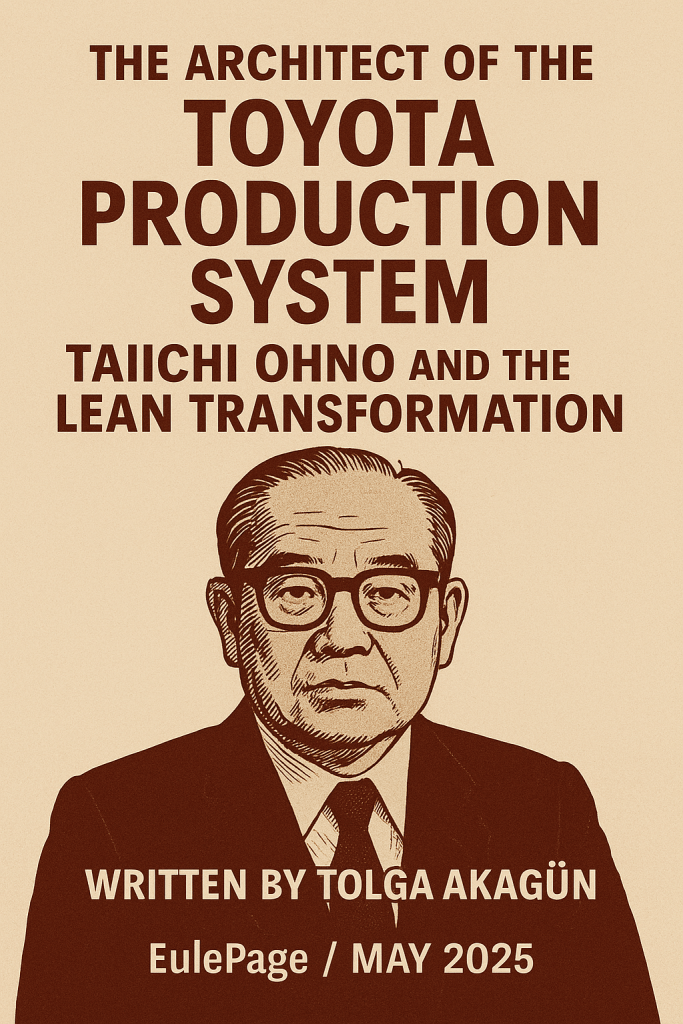
The Architect of the Toyota Production System: Taiichi Ohno and the Birth of Lean Transformation
Written by: TOLGA AKAGÜN
Publication: EulePage / May 2025
Introduction
Taiichi Ohno, one of the key figures shaping the industrial revolution of the 21st century, is recognized not only as a pivotal name in Japan but also as a central figure in the evolution of global production systems. The Toyota Production System (TPS), developed by Ohno, initiated a transformation that emphasized efficiency, quality, and agility—not only in the automotive industry but also across sectors such as healthcare, service industries, software engineering, and educational management. This system later became the foundation of a production and management paradigm that would be adopted worldwide under the name “Lean Production.”
Defining Waste:
“Muda” and Value Orientation
Ohno’s production philosophy is based on an approach that aims to eliminate all activities in the production process that do not create value. The Japanese term “muda,” meaning “waste,” refers to inefficient, excessive, or non-value-adding steps within the production process. Through meticulous observation of production systems, Ohno identified seven types of waste:
- Overproduction
- Waiting times
- Unnecessary transportation
- Overprocessing or repeated processing
- Excess inventory
- Unnecessary motion
- Production defects and errors
This classification not only made waste visible but also paved the way for developing systematic solutions to eliminate it. What set Ohno apart was his reliance not on theoretical frameworks but on direct observation and experience in the field.
Continuous Improvement and a Participatory Culture
In Taiichi Ohno’s production philosophy, Kaizen, or “continuous improvement,” is a fundamental cornerstone. According to this principle, achieving excellence in the system is only possible through the contributions of all employees, not just managers. Every worker must be empowered to recognize problems in their tasks, develop solutions, and improve processes. For this reason, the Toyota Production System (TPS) is built not on traditional hierarchical structures but on a horizontal communication model that encourages employee participation.
To support this approach, Ohno introduced practices such as the Andon system. Through Andon, any worker who identifies a quality issue on the production line is authorized to halt production. This system integrates quality control into the production process itself, enabling early detection of errors and preventing their recurrence.
The Place of Truth: The Gemba Principle
One of the most striking aspects of Taiichi Ohno’s management philosophy is the concept of “Gemba,” which means “the real place” in Japanese. Gemba refers to the actual location where production takes place. According to Ohno, real knowledge is not found in office reports but on the shop floor itself. Therefore, instead of making decisions from behind a desk, managers should go to the production site, observe firsthand, and seek solutions at the source of the problem.
Ohno’s statement perfectly summarizes this philosophy:
“A manager’s job is not just to look at the numbers, but to see and understand firsthand what is happening on the production line.”
This approach not only strengthens today’s data-driven decision-making processes but also integrates seamlessly with a human-centered management culture.
Global Lean Transformation: Ohno’s Legacy
Ohno’s hands-on management philosophy gained recognition in Western academic literature starting in the 1980s under the name “Lean Manufacturing.” This philosophy has influenced not only the manufacturing sector but also healthcare, education systems, public administration, and software development processes. For example, many hospitals in the United States have used lean principles to reduce patient waiting times and simplify processes, thereby lowering costs.
Today, lean thinking is not just a production model; it is a management approach guiding areas such as sustainable development, environmental responsibility, human resource management, and digital transformation. The principles embedded in Ohno’s system—simplification, decentralized decision-making, collaboration, flexibility, and quality—also form the foundation of modern management approaches such as Industry 4.0, agile management, and Total Quality Management (TQM).
Conclusion
Taiichi Ohno was not only a production engineer but also a pioneer who transformed modern organizational thinking. The system he developed has been globally recognized not only for making production processes more efficient, error-free, and humane but also as a management culture and life philosophy. Ohno’s philosophy, based on simplification, on-site observation, and continuous improvement, continues to offer lean solutions to the complex challenges faced by today’s organizations.
References
- Ohno, T. (1988). Toyota Production System: Beyond Large-Scale Production. Productivity Press.
- Liker, J. K. (2004). The Toyota Way: 14 Management Principles from the World’s Greatest Manufacturer. McGraw-Hill.
- Womack, J. P., & Jones, D. T. (1996). Lean Thinking: Banish Waste and Create Wealth in Your Corporation. Simon & Schuster.
- Rother, M., & Shook, J. (2003). Learning to See: Value Stream Mapping to Add Value and Eliminate MUDA. Lean Enterprise Institute.
- Dennis, P. (2002). Lean Production Simplified: A Plain-Language Guide to the World’s Most Powerful Production System. Productivity Press.
 EulePage
Yorum yazabilmek için oturum açmalısınız.